
An ancient temple, which dates back to Sambuvarayar and Vijayanagara kings on the top of an easily accessible hillock set in a sylvan surrounding exists in Vellore District, Tamil Nadu, India.
The various inscriptions on the north, south and western walls tell the history of the temple. Lord Vishnu depicted in the form of NARASIMHAN i.e. half man-half lion, is denoted as AVAPULANAYANAR..
Raja Narayanan, the first Sambuvarayar king, perhaps made the present structure in 1363 A.D. where the Lord was known to be present from 8th century onwards in a smaller shrine.
In another document on the wall dated 1428 A.D., states that it was built by a king of Vijayanagara period noted the Lord as SINGAPERUMAL and the village as OBILAM .
The entire surrounding is beautiful and serene with a river on one side and a small lake on the other side. The entire place is a thick forest with a mountain range.
The swing hall must have been a magnificent once upon a time but today has a forlorn air and is in a badly dilapidated state.
In fact vandalism continues even today; visitors engrave their names on the walls as seen in the rock wall in outer ring near the shrine.
The name Singri may be derived from Singam –because of the way the Lord is depicted here.(Singam –lion; giri—mountain = SINGIRI). The word Obilam by which the village was known also has a meaning. Obilam is a shortened version of a compound word OPPU - ILLA which means incomparable, denoting the Lord himself. The Lord also has a name OPPILLI which means incomparable. Hence the village where the Lord lives also goes by the same name.
The temple is bestowed with various endowments. The temple title has 29.41 acres of land of which 2 acres are taken over by government for housing of the economically weaker Arunthathiars for a sum of Rs 8000 which is in the form of a fixed deposit. The interest accrued is used for oil for the lamps. One acre and 68 cents land is being used by temple Archahars (the traditional priests). The rest is on lease for Rs 21,000 rupees annually which is credited to the bank.
The ASI had done a survey and the temple is found to be 1300 years old as per the inscriptions on the wall.
In 2007 A.D. Kumbhabishaham was performed. In 2014 the Raja Kopuram at the back of the temple was renovated.
The temple is very clean and being well taken care of by traditional Archahars for the past 15 generations of the family. But the outer stone walls have been abused by vandals.
Buses ply from the old bus stand in Vellore, but the frequency is less. There is a bus at 9 a.m. which directly goes to Singiri and the return service is around 2 p.m from Singiri. Another option is to take a bus to Kizh Arasampattu from where a shared auto can be taken .The shrine is kept open from 6 a.m.to 1 p.m. and again from 4 p.m.to 7 p.m.

A photograph taken when nearing the temple
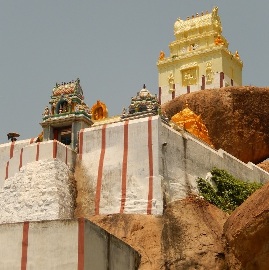
From just below the temple
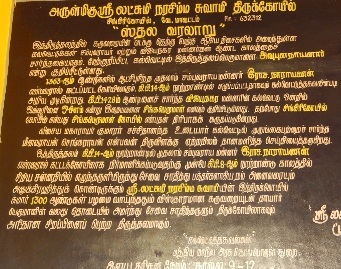
The flex board tells the story of the temple
About the Temple
The Lord Vishnu is seen here as Singa Perumal with Sri Lakshmi Devi seated on the right side lap which is unique whereas in most of the SINGA PERUMAL Temple the Lord has His consort seated on the left side.
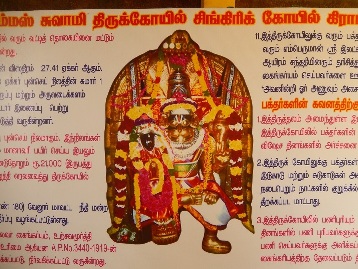
The photograph of the Lord Sri Singaperumal with Sri Lakshmi Devi seated on His right lap as present in the sanctum.
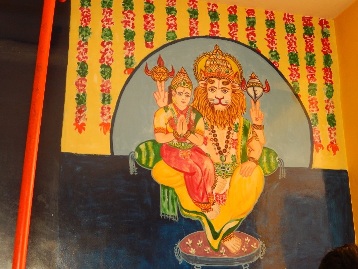
The pictorial representation of the Lord in the form of Sri Lakshmi Narasimhar where Sri Lakshmi is seated on the right lap of the Lord which is unique.
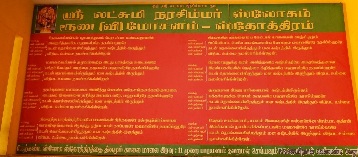
The Sri Lakshmi Narasimhar Prayer.
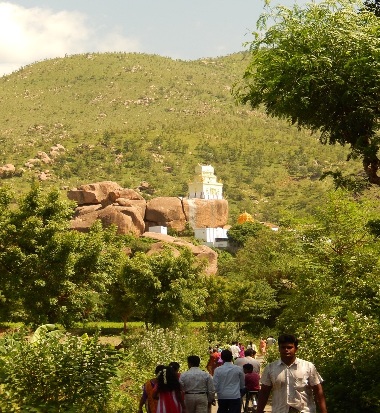
The beginning of the walk to the temple
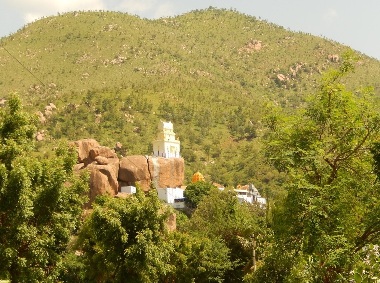
From Singiri village the pilgrim needs to walk for 10 mts. and cross the river bed to reach base of the hillock and has to take a flight of steps to reach the entrance of the temple. The steps have a roof to give protection from the scorching sun. A 15 mts climb is needed and it is not difficult to climb.
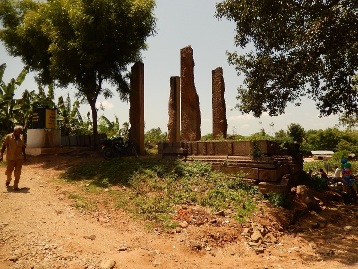
The dilapidated swing hall – a feature seen in most of the Lord Vishnu temples; this is on the river bank which at present is completely dry.
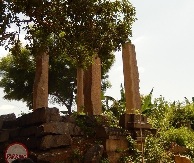
Forlorn swing hall which has an abandoned air about it
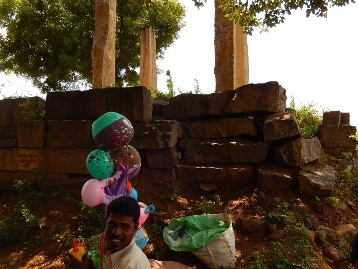
Close-up of the swing hall -1
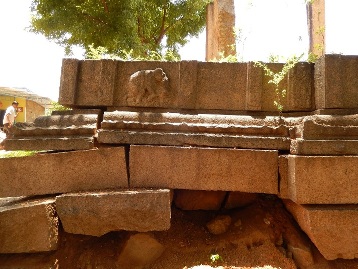
Close-up of the swing hall -2
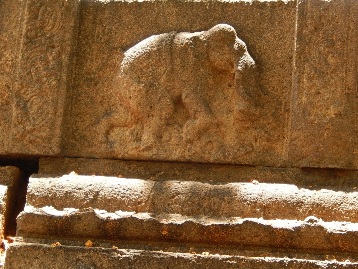
Close-up of the swing hall with sculptures - 3
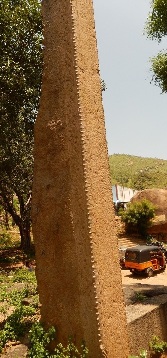
Close-up of the pillar of the swing hall
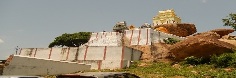
First view from the outside
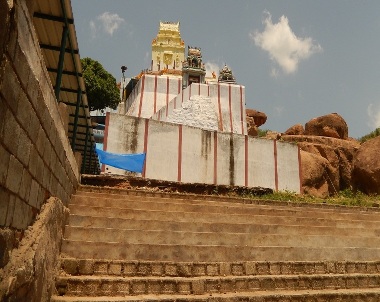
Steps leading to the temple
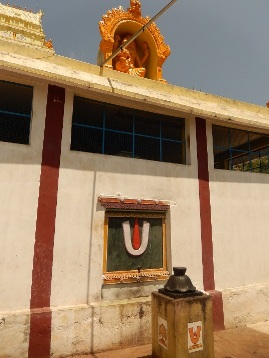
At the entrance where the sacrificial stone is kept. Now this gate is walled off and worshippers have to enter the sanctum through the entrance kept on the side.
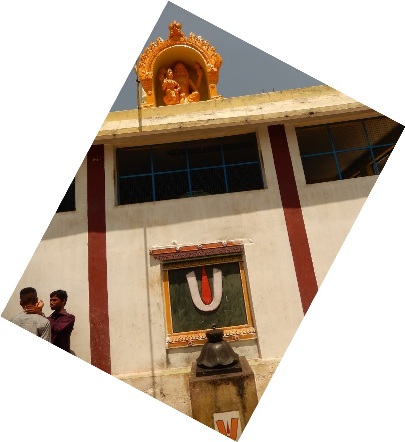
Close-up of the sacrificial stone

The foyer on the side, which leads to the hall where social functions are undertaken.
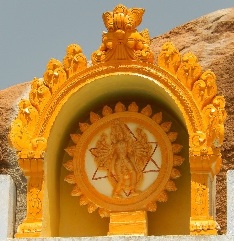
Lord Sudharsan, also known as Chakrathalwar, the destroyer of all evil. The sick and infirm worship Sri Sudharsan.
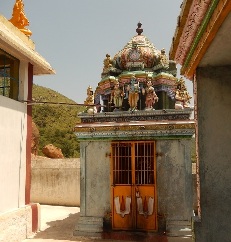
The shrine which houses Lord Veera Hanuman seen on the right side of the sacrificial stone.
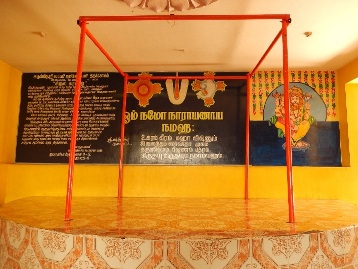
The hall where various functions are held.

The Lakshmi Narasimhar Sanskrit slogam written in Tamil as Tamil literation.
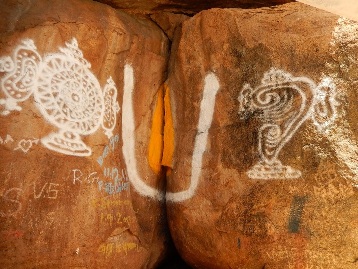
A small cave on the outer circle.
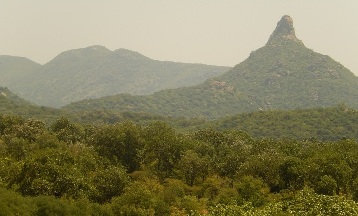
A picturesque view from around the temple.
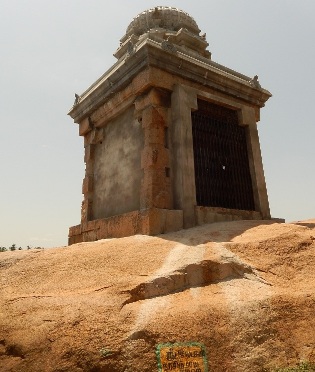
A shrine intended to house Sri Perumal.

The stairway leading to the temple; halfway through, a four pillared mandapam is located .The pillars contain engraved figurines viz. human, animal and floral designs.

Probably a member of the from the royal family who built this shrine. This is a custom in most of the structures built by Nayaka kings where they are portrayed with folded hands greeting the worshippers. In several other shrines, they are seen along with their spouse as well.

A pot - POORNA KUMPH - supposed to contain the Blessed Nectar.
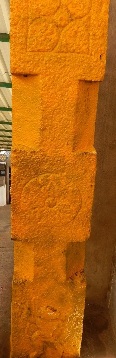
A pillar with engraved designs
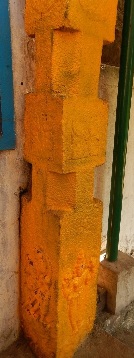
Close-up of the engravings

Close-up of the engravings - floral design - 1
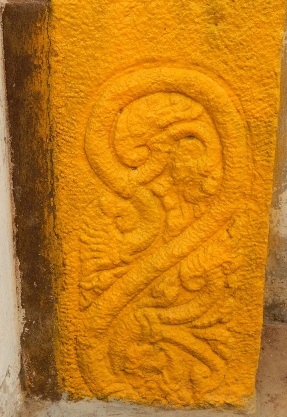
Close-up of the engravings - floral design- 2

Close-up of the engravings - floral design - 3

Close-up of the engravings - floral design - 4
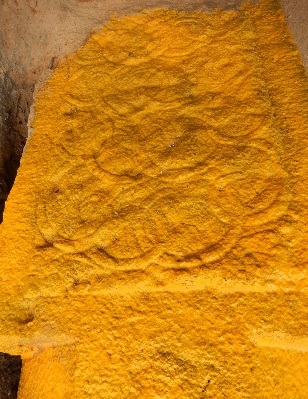
Different floral design - 1
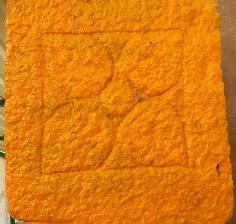
Different floral design - 2
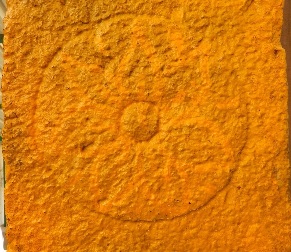
Different floral design - 3

Different floral design - 4
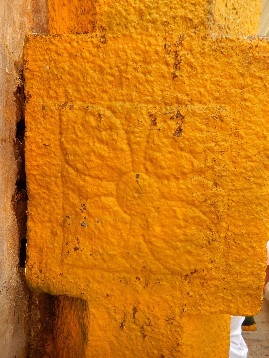
Different floral design - 5

A miniature elephant, a legendary creature which was known as KAL YANAI in Tamil, which no longer exists.

A mythical creature.

A monkey with a fish in the hand.

A bird, the nature of which is unclear.

Bramhahathi which is on the watch.

Lord Narasimhan emerging from the pillar.
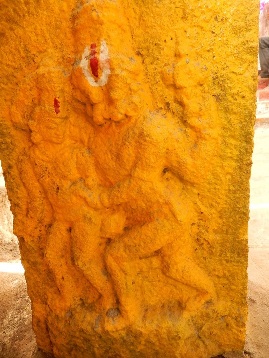
Lord Narasimhan getting hold of Hiranyakashibu, the Demon king.

Lord Vishnu.

Lord Vishnu in a seated form along with the consort (an unusual way of depiction) where Hanuman is seen in standing posture (in reverence)

A fighting scene.
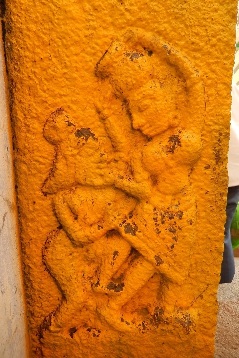
Another intricate engraving
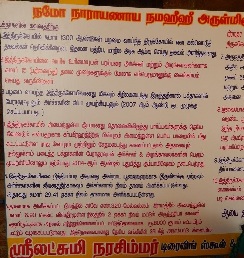
The flex board showing the property bequeathed towards the temple.
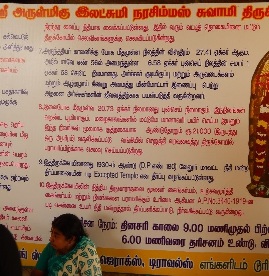
The details of the property